
Airflow Boosting - How to increase air flow in ducts
Have you experienced a room in your home that never seems to reach the temperature set on your thermostat? You are likely dealing with an airflow bottleneck in your ductwork. When conditioned air cannot reach its destination in sufficient volume, rooms become uncomfortably hot during summer months and uncomfortably cold during winter months. Before concluding that your central air conditioner or furnace needs total replacement, it helps to analyze why air distribution fails and evaluate technical equipment options to restore thermal balance.
What Causes Airflow Bottlenecks in Your Home?
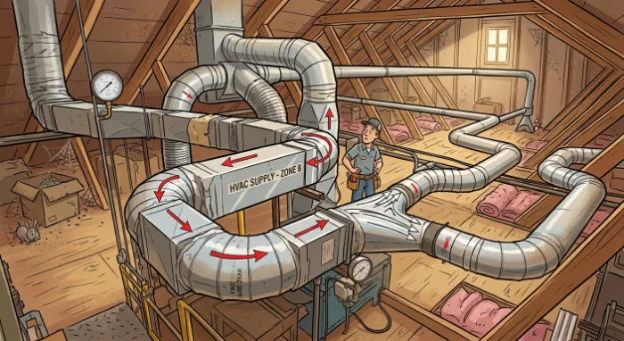
Central heating and cooling systems rely on external static pressure (ESP) to push conditioned air through duct manifolds. When friction resistance along a duct run exceeds the pressure capacity of your primary air handler blower, air velocity drops off sharply. This distribution failure typically stems from specific structural issues:
- Long duct pathways: The further air travels from your central furnace or air handler, the more friction it encounters against the duct walls. This friction steadily reduces air speed over long distances.
- Sharp turns and bends: Flexible ducts or sheet metal runs with multiple elbows create air resistance. Every 90 degree turn acts like a speed bump, slowing down air volume.
- Home additions and finished basements: When you add a room, finish an attic, or convert a basement, those new vents are attached to the end of an existing duct system. Your air handler might not have been sized to handle that extra distance.
- Closed doors and pressure imbalances: When supply registers blow air into a room with a closed interior door and no dedicated return grille, static pressure builds up inside that space. High pressure inside the room resists incoming supply air, effectively blocking new warm or cool air from entering.
What Can You Do?
The first step in determining whether an airflow booster or pressure balancing system fits your application. In some instances, a poorly regulated room stems from insufficient attic insulation, single-pane windows, direct solar heat gain, or major leaks in exposed ductwork.
After verifying that those structural issues are not the primary cause, dedicated mechanical air boosting provides a direct fix. Airflow boosters and pressure balancers add dedicated mechanical force or air relief pathways right where pressure drops occur. The question remains though;
Which Solution is Right For You?
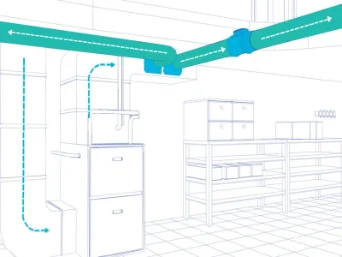
Inline Duct Booster Fans
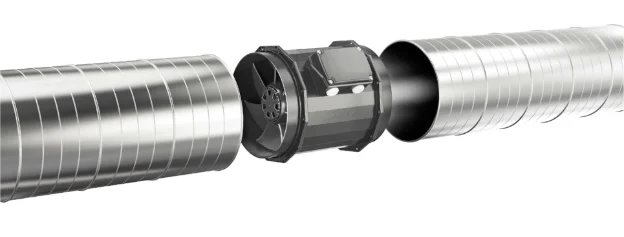
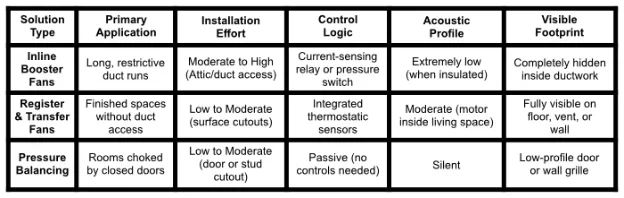
Inline fans install directly into round flexible or rigid metal branch ducts located inside attics, basements, or crawlspaces. When your central system turns on, a pressure switch or current-sensing relay signals the inline fan to energize simultaneously, creating a localized vacuum that pulls additional air through restrictive ductwork.
Key Models
- Ruck Air Movement Prime Evo EC Series: High-static mixed-flow fans featuring integrated 0-10V EC motor controllers.
- Fantech PrioAir Series: Heavy-duty, 5VA, composite plastic, mixed-flow fans available with high-efficiency EC motors for 0-10V speed control.
- S&P TD and TD-SILENT Series: Acoustic mixed-flow inline fans built with perforated inner skins and sound-absorbent insulation layers.
Pros
- Superior Pressure Performance: High static pressure capabilities overcome extreme friction loss in long duct runs up to hundreds of feet.
- Zero Living Space Visibility: Installed completely out of sight within attic spaces, ceiling cavities, or basements.
- Automated Syncing: Pairs cleanly with current-sensing relays (like current switches clamped to the main blower lead) or differential pressure switches to turn on automatically with the furnace.
- Quiet Operation: Premium silencer models damp acoustic energy before air reaches living areas. Flexible duct and silencers can be added to the duct to reduce noise further.
Cons
- Installation Complexity: Requires physical access to exposed ductwork, mounting brackets to structural joists, and 120V electrical wiring.
- Control Requirements: Must install a secondary relay or pressure switch so the fan does not run continuously.
Register Boosters and Room-to-Room Transfer Fans
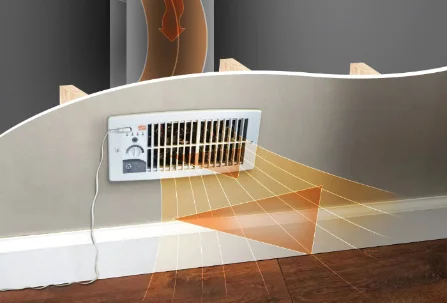
When ductwork is completely concealed behind finished drywall with zero access for inline fans, register boosters and wall-mounted transfer fans provide direct airflow assistance at the room boundary.
Key Models
- Suncourt HC500 Flush Mount and HC 600 EZ8 Register Boosters: Vents featuring integrated multi-speed wall fans designed to drop directly into floor or wall registers.
- Tjernlund AireShare Series: Wall-cavity transfer fans designed to draw conditioned air from a hallway or main room and discharge it into an adjacent space.
- Suncourt TW Series: Variable-speed room-to-room transfer fans engineered for through-wall installations between adjacent living areas.
Pros
- High Installation Ease: Direct surface installation requires no attic or crawlspace access. Register boosters simply fit over existing duct boot cutouts.
- Built-in Temperature Controls: Many units include integrated thermostatic sensors that automatically detect warm or cool air at the register vent.
- Low Initial Investment: Lower equipment hardware cost compared to inline duct installations.
Cons
- Visible Living Space Footprint: Fans and grilles remain fully visible on floor vents, supply walls, or interior partition walls.
- Acoustic Proximity: Because the motor operates right at the room border, fan motor noise is more audible compared to insulated attic-mounted fans.
- Limited Pressure Capability: Effective at pulling air through the final register opening, but cannot overcome severe upstream duct crushing or long-run static drag like a heavy-duty inline centrifugal fan.
Return Air Pressure Balancing
When closed interior bedroom doors create high room pressure that repels supply air, passive return pathways restore air circulation across the home without adding power draw.
Key Models
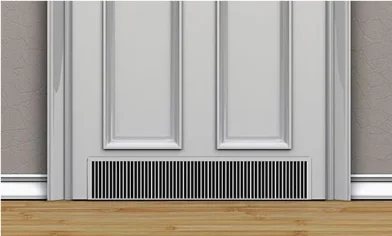
- Tamarack Perfect Balance In-Door Pressure Balancers: Low-profile door grilles installed into the bottom section of standard 1-3/8 inch interior doors.
Pros
- Zero Power Consumption: Operates passively without electricity, fans, or control switches.
- Zero Operating Sound: Completely silent air transfer that eliminates door-slamming pressure spikes.
- Protects Primary HVAC Equipment: Prevents main air handler blower strain caused by starved return air paths.
Cons
- Requires Door or Drywall Cutting: Installation involves cutting a rough opening into interior doors or framing out an opening above door headers.
- Passive Air Movement Only: Relies on pressure differentials created by the central blower; does not actively pull additional CFM through under-sized supply ducts
Restoring Balance to Your HVAC System
Eliminating persistent hot and cold spots comes down to choosing the right tool for your specific mechanical layout. If you have exposed duct runs in an attic, basement, or crawlspace, installing a high-static inline duct fan provides maximum airflow with silent operation and zero visual footprint. If your ductwork is fully enclosed behind drywall, register boosters and room-to-room transfer fans deliver targeted relief directly at the room boundary. Finally, if closed interior doors are starving your central HVAC return, passive pressure balancing pathways allow conditioned air to circulate freely across your entire home.
Airflow Boosting Categories:
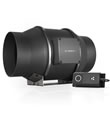
Inline Air Booster Fans
Air booster fans are used inline when the main fan does not have enough capacity to blow air through long or convoluted duct runs
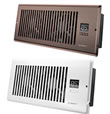
Register and Room-to-Room Boosters
Room to room and register boosters are simple to install fans designed to boost airflow.
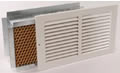
Pressure (Air) Balancing
Relieve pressure build up in the home by allowing the movement of air from one room to the next. Wall and door air pathways.
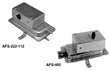
Pressure Switches
Pressure switches for gases (usually for air) and liquids. Proving switches.
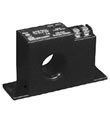
Current Switches
Current switches used to activate booster fans. Also used for boosting clothes dryers.
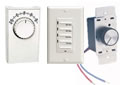
Exhaust Fan Controls
Electronic timers, humidity switches, and fan speed controls.
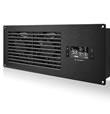
AV Closet Cooling
Fan system designed for cooling AV equipment rooms, closets, and larger enclosures.
Draft Inducers and Chimney Fans
These fans can be used to improve the draft of a wood fired chimney.
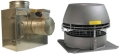
Power Venters
Used for side wall venting residential/light commercial natural gas, LP or oil fired equipment including: furnaces, boilers, water heaters and unit heaters.

why buy from us?
We're engineers passionate about home ventilation and serious about customer service – so you can count on us for carefully-selected equipment and expert advice to ensure your project is a success from specification to installation.
Your call is answered by qualified people who will gladly discuss your project in detail, advise you professionally and never sell you inappropriate products.