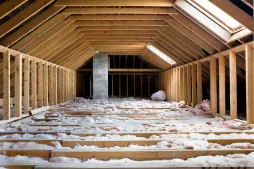
Exhaust Hot Air from Your Attic
Have you climbed into your attic on a summer afternoon and felt the heat hit you like an open oven? Or noticed frost on the underside of the roof deck in winter? Both are signs of an attic that is not breathing properly. A well ventilated attic keeps your roof system healthier, your living space more comfortable, and your cooling system from working harder than it should. Before you pick a fan or a vent, it helps to understand how attic airflow works and how much of it you need.
Why Does Attic Ventilation Matter?
An attic sits between your living space and the weather. In summer, the sun heats the roof deck and that heat builds up in the attic. In winter, warm, moist air from the home leaks upward and condenses on cold surfaces. Without a steady flow of outdoor air through the space, the problems stack up:
- Heat buildup: Trapped heat radiates down through the ceiling and adds to your summer air conditioning load.
- Moisture and mold: Humid air from bathrooms, kitchens, and everyday living collects in the attic, feeding mold, mildew, and wood rot.
- Ice dams: In cold climates, a warm roof deck melts snow that refreezes at the eaves and can back water up under the shingles.
- Shortened roof life: Excess heat and moisture age shingles, sheathing, and framing faster.
- Lost insulation performance: Damp insulation does not insulate as well.
How Much Ventilation Do You Need?
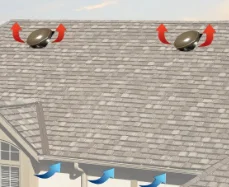
A ventilated attic works like a chimney. Cool outdoor air enters low through soffit (intake) vents, picks up heat and moisture, and leaves high through roof, ridge, or gable (exhaust) vents. Two rules drive the design.
1. Size by net free area. Net free area (NFA) is the actual open space air can pass through after screens and louvers are accounted for. Our rule of thumb is 1 square foot of free ventilation area for every 150 square feet of attic floor space.
2. Balance intake and exhaust 50/50. Half of your free area should be intake at the soffits or eaves and half should be exhaust at or near the peak. Exhaust should never exceed intake. If it does, a fan or vent will pull the make-up air it needs from somewhere else, including your living space.
Example sizing at 1 sq ft per 150 sq ft:
Divide your total area by 150 to give you sq ft of total ventilation, then multiply by 144 to give you sq in of total ventilation.
- 1,000 sq ft attic: 960 sq in total, 480 sq in intake and 480 sq in exhaust
- 1,500 sq ft attic: 1,440 sq in total, 720 sq in intake and 720 sq in exhaust
- 2,000 sq ft attic: 1,920 sq in total, 960 sq in intake and 960 sq in exhaust
- 2,500 sq ft attic: 2,400 sq in total, 1,200 sq in intake and 1,200 sq in exhaust
- 3,000 sq ft attic: 2,880 sq in total, 1,440 sq in intake and 1,440 sq in exhaust
What Can You Do?
Start with the intake. Soffit vents are often blocked by insulation or paint, and no exhaust fan can fix an attic that cannot draw in air. Seal air leaks in the ceiling below, such as around recessed lights, attic hatches, and duct and wire penetrations, so conditioned air is not pulled up into the attic. Make sure bathroom fans, kitchen hoods, and dryers exhaust outdoors and never into the attic or into the soffit that feeds it.
Then choose your exhaust. The question remains: which solution is right for you?
Which Solution Is Right for You?
Powered Attic Fans
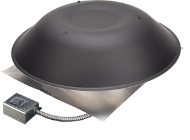
Powered fans move a large, predictable volume of air and are controlled by a thermostat, with an optional humidistat to run in winter when moisture is the problem. They come in roof mount and gable mount versions.
Key Models
- GAF Master Flow Power Attic Vent, Roof Mount (ERV5, ERV6): 1,250, and 1,500 CFM for attics up to 2,200, and 2,800 sq ft. Adjustable thermostat included, optional humidistat/thermostat (HT models), 15 inch opening, for roof pitches 2:12 to 12:12. The ERV6 carries a 10 year limited warranty.
- GAF Master Flow Power Attic Vent, Gable Mount (EGV5, EGV6): 1,450 and 1,600 CFM for attics up to 2,300 and 3,000 sq ft, with an energy efficient PSC motor and thermostat. UL listed in the US and Canada.
- GAF Master Flow EZ Cool Plug-in (EZCR1): 1,050 with a 25 foot power cord that plugs into a standard 110v grounded outlet in the attic, so no hardwiring is needed. Factory preset thermostat. ETL listed.
- GAF Master Flow Wi-Fi Attic Vent (ERV5QCT roof mount, EGV5QCT gable mount): Control the vent from a smartphone or tablet through the QuickConnect app, with an adjustable humidistat, thermostat, and timer. Handy for vacation homes and rentals.
- Lomanco LomanCool Roof Mounted (2000): All-aluminum construction with a 1/10 HP, 120 volt motor and a 12 inch, five blade fan. Factory set, adjustable thermostat that switches on at 100 degrees and off at 85 degrees, with a push to test button. Available in black, or brown. Lomanco recommends one 2000 for attics up to 1,000 sq ft, two for 1,500 to 2,000 sq ft, and three for 2,500 to 3,000 sq ft
- Lomanco Addavent Gable Mounted (1800): Mounts behind an existing gable louver on 16 or 24 inch framing. Factory set, adjustable thermostat that switches on at 100 degrees and off at 85 degrees, with a push to test button., Lomanco recommends the 1800 for attics up to 1,000 sq ft.
Pros
- High airflow: 1,050 CFM handles larger attics and hot climates.
- Automatic control: Thermostat and optional humidistat run the fan only when it is needed.
- Plug-in and Wi-Fi options: Skip hardwiring or monitor from anywhere.
Cons
- Uses electricity: Operating cost and motor wear, though modern PSC motors are highly-efficient.
- Needs enough intake: An undersized intake can depressurize the attic and pull air from the home. Check intake first.
Solar and Hybrid Attic Fans
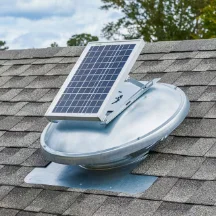
Solar fans remove the electrical connection entirely. They run when the sun is shining, which is also when the attic needs the most help.
Key Models
- GAF Master Flow GreenMachine Solar-Powered Roof Vent (ERVSOLAR): Up to 525 CFM with a fully adjustable, impact resistant 15 watt solar panel and a brushless motor that needs no maintenance.
- GAF Master Flow GreenMachine Dual-Powered Roof Vent (ERVHYBRID): Hybrid design that switches automatically between solar and house power for 24/7 operation, up to 500 CFM on solar and 750 CFM on house power. GAF reports up to 80% less electricity than a standard electric power vent when running on house power.
Pros
- No wiring and no operating cost: Ideal when an electrician is hard to schedule or no power is in the attic.
- Runs when it is hottest: Output tracks sun on the roof.
- Hybrid keeps going: The dual-powered model keeps pulling moisture out after dark.
- Lower airflow: Rated CFM is lower than comparable powered fans, so larger attics need more units. GAF recommends 2 solar vents for 1,600 sq ft, 3 for 2,400 sq ft, and 4 for 3,200 sq ft.
- Sun dependent: Shade, orientation, and weather affect performance.
A note on airflow numbers: manufacturer CFM ratings are measured in a laboratory at zero static pressure. Real installations with screens, restricted intake, and wind will deliver less, which is another reason to size your intake generously.
Passive (Static) Attic Vents
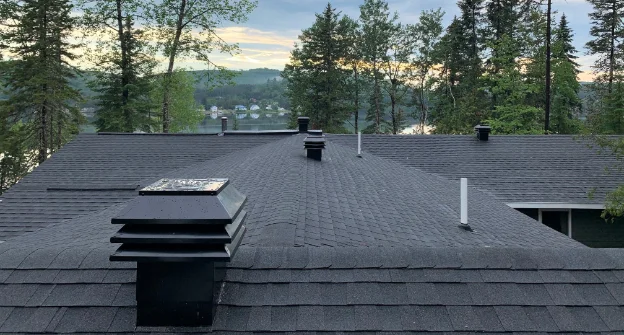
With no motor and no moving parts, static vents rely on wind and the natural rise of hot air. They are the quiet, maintenance free choice and a good fit when the attic is well balanced and the climate is moderate.
Key Models
- Ventilation Maximum Sloped Roof Ventilators (VMAX-303-12, 301-12): Storm proof deflector keeps rain and snow out without a turbine. Net free evacuation of 105, and 144 sq in per unit. Galvanized steel with a powder coated finish in black, brown, or grey. Adjustable flashing fits slopes from 2/12 to 15/12.
- Primex low profile and goose-neck roof vents (RVL28, RV28, RV20): Molded polymer hoods with built-in screens and a removable damper. The RV28 adds 5 inches of height for snow clearance.
Pros
- Zero electricity and zero maintenance.
- Silent.
- Easy to count: Published net free area makes balancing against your intake straightforward.
Cons
- Airflow depends on wind and temperature: Less capacity on still, hot days than a powered fan.
- More vents may be needed: Each unit contributes a modest amount of free area, so you add vents until the total matches your target.
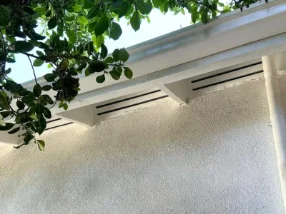
Soffit Vents (Intake)
Intake is half of the equation, and it is the part most often neglected. Soffit vents bring in the cool outdoor air that powers the whole system.
Key Models
- Primex RDV Round Soffit Vent Series: 2 to 6 inch round vents with a molded-in bug screen and an extra long collar. Free area runs from 1.1 sq in (2 inch) to 10.3 sq in (6 inch).
- Primex SV6x9 Soffit Vent: 6 by 9 inch vent with an optional access frame, molded-in screen, and 15.7 sq in of free area.
Pros
- Simple to add: No roof penetration needed.
- Pest resistant: Built-in screens keep birds and insects out.
Cons
- Small free area per vent: Plan on several to reach your intake target.
Protect Your Vents From Wildfire Embers

In wildfire country, one of the most common ways a home ignites is not the flame front but wind-blown embers that travel for miles and slip into an open vent. BrandGuard Vents were created by a firefighter who saw this firsthand.
Their three layer approach combines an overlapping baffle design with 1/16 inch mesh that forces embers to turn corners and then catches what remains, intumescent strips that expand to seal the vent opening when temperatures climb, and a non-combustible 26 gauge, grade 90 steel body in galvanized, stainless, or copper, paint matched to blend with your home. Fire rated vents are available for attic and crawlspace openings.
Keep Fan Exhaust Out of the Attic
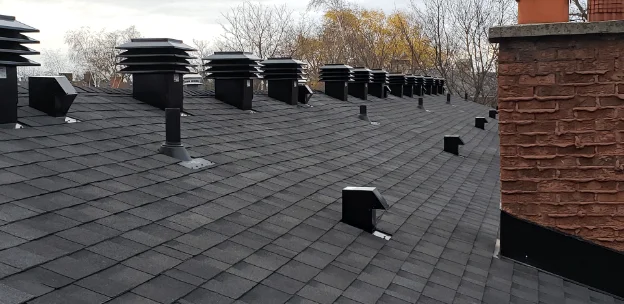
Bathroom fans, kitchen hoods, and dryers should never discharge into the attic or the soffit that supplies it. That moist air only re-enters the attic and defeats the purpose of ventilation. Ventilation Maximum makes this point clearly: a 110 CFM bath fan puts 110 cubic feet of moist air into an attic every minute it runs. Roof exhaust caps carry that air outdoors.
- Ventilation Maximum Roof Exhaust Traps (VMAX-CT-4, CT-6, CT-10): Sit 5 3/4 inches off the roof, with a built-in damper, anti-gust deflector, and rodent proof screen. Steel construction with a limited lifetime warranty on manufacturing defects.
- Primex RV20 low profile roof vent: Fits 4, 5, or 6 inch duct with the included RV45 adapter. Exhaust or intake with a removable damper.
- Primex RV28 goose-neck and RVL28 low profile roof vents: 4 to 8 inch duct with snap-in adapters. The RVL28 suits high wind areas and the RV28 adds snow clearance.
Restoring Balance to Your Attic
Getting attic ventilation right comes down to four steps. Size your total free area at 1 square foot per 150 square feet of attic floor. Split it 50/50 between intake and exhaust. Choose the exhaust that fits your roof and your power situation: a powered fan for maximum airflow, a solar or hybrid fan to skip the wiring, or a static vent for silent, maintenance free performance. And finish with the extras that complete the system: fire rated vents where embers are a concern, and roof discharge caps so fan exhaust never lands in your attic.
Attic Ventilation Products
Attic Fans - Powered
Electric powered attic fans for attic exhaust. Typically powered by 120 VAC from a circuit in the home.
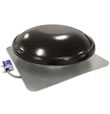
Attic Fans - Solar
Attic fans powered by a solar panel. No need for expensive electrical wiring and no power cost.
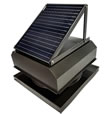
Attic Vents
Non-powered vents for attics and similar spaces. Turbine vents, whirlybirds, louvers, ventilated frieze blocks, etc.
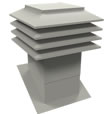
Discharge Caps - Roof
Roof mounted caps and vents. Available in plastic, galvanized steel, stainless steel and copper.
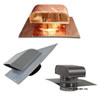
FIRE RATED Vents
Vents that resists the intrusion of flame and embers into your attic/crawlspace through the building’s vents, thus protecting your home from dangerous flying embers created by wildfires.
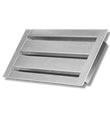
Soffit Vents
Caps and grilles for venting of soffits or exhausting through a soffit area. Soffit vent caps can be used for dryer, bathroom or general exhaust applications.

why buy from us?
We're engineers passionate about home ventilation and serious about customer service – so you can count on us for carefully-selected equipment and expert advice to ensure your project is a success from specification to installation.
Your call is answered by qualified people who will gladly discuss your project in detail, advise you professionally and never sell you inappropriate products.